
- All
- Product Name
- Product Keyword
- Product Model
- Product Summary
- Product Description
- Multi Field Search
Views: 0 Author: Site Editor Publish Time: 2026-07-24 Origin: Site
Medical device manufacturing operates under incredibly high stakes. Producing negative displacement needle-free connectors demands absolute precision on the factory floor. Even microscopic assembly flaws can cause severe clinical complications. Patients face severe risks, including Catheter-Related Bloodstream Infections (CRBSI), if these devices fail. Negative needle free valve connector machinery serves as the critical bridge solving this problem. It connects strict clinical design requirements—like minimal dead space and exact silicone sealing—directly to high-yield commercial viability. Relying on outdated or manual assembly methods puts both patient safety and production targets at immense risk.
This article explores how upgrading to automated, precision assembly equipment fundamentally transforms your production floor. You will discover its direct impact on Overall Equipment Effectiveness (OEE) and stringent regulatory compliance. We will also examine how automated production lines streamline operational scaling while maintaining pristine quality control standards.
Automated machinery replaces high-risk manual handling, drastically reducing bio-burden and contamination risks during assembly.
Inline testing (vision systems and pressure decay) ensures every connector meets strict clinical tolerances, minimizing scrap and preventing costly recalls.
Transitioning to advanced manufacturing lines requires evaluating cleanroom footprint, changeover times, and vendor Validation (IQ/OQ/PQ) support.
The right machinery investment lowers long-term Cost per Part (CPP) while strictly adhering to ISO 13485 and FDA regulatory standards.
Negative displacement connectors function through a highly specific mechanical action. When a clinician disconnects a syringe, the internal mechanism creates a slight vacuum. The device must manage internal dead space flawlessly to prevent drawing blood back into the catheter tip. This clinical requirement dictates microscopic manufacturing tolerances. The internal silicone gland must rebound perfectly every single time. If manufacturing equipment over-compresses the silicone seal, the connector fails completely.
Legacy systems simply cannot meet these demands at modern production volumes. Semi-automated or manual assembly lines bottleneck the entire operation. Human operators struggle to maintain consistent silicone compression across thousands of units. Manual handling frequently causes micro-abrasions on delicate valve housings. These tiny scratches compromise the sterile fluid pathway. Furthermore, manual assembly output speeds remain painfully slow, crippling facility profitability.
Defining success requires establishing strict, measurable criteria before upgrading equipment. A successful machinery upgrade must achieve a yield rate exceeding 99 percent. It must generate compliance-ready automated audit trails. Cycle times must drop significantly. True success means transforming an unpredictable assembly process into a repeatable, highly controlled scientific operation. Facilities must eliminate variability to protect end-users and shield the brand from catastrophic product recalls.
Modern assembly lines integrate advanced technologies to eliminate human error entirely. The heart of these machines relies on precision silicone valve insertion. Robotic actuators carefully handle the internal silicone gland. They prevent over-compression or tearing during the high-speed insertion phase. Precise torque and force feedback ensure the negative displacement mechanism functions flawlessly upon deployment.
Automated joining technologies represent another massive leap forward. Legacy gluing methods often leave toxic residues or create inconsistent seals. Modern machinery utilizes ultrasonic welding or UV curing stations instead. Ultrasonic welding uses high-frequency vibrations to melt the plastic housing components together seamlessly. The machinery exerts automated dosage and pressure control during this process. This exact control completely eliminates micro-leaks along the connector seams.
Scaling output requires robust high-speed indexing systems. Manufacturers typically utilize either rotary dials or linear transfer systems. These systems synchronize complex multi-part assembly tasks perfectly. They guide the housing, valve, and base through various stations simultaneously. This synchronized movement dramatically increases units-per-minute (UPM) output without ever sacrificing quality.
The transition from legacy methods to automated platforms delivers measurable advantages across the board:
Force-monitored insertion: Actuators measure the exact physical force applied to the silicone valve, rejecting any parts experiencing abnormal friction.
Synchronized curing: UV light stations apply precise wavelengths for exact durations, guaranteeing uniform bond strength.
Vibration-free indexing: Advanced servo motors move components between stations smoothly, preventing misalignment prior to final welding.
| Assembly Stage | Legacy Manual Method | Automated Machinery Feature | Direct Production Outcome |
|---|---|---|---|
| Silicone Insertion | Manual tweezers or hand pressing | Robotic force-feedback actuators | Eliminates torn valves and improper seating |
| Component Joining | Manual adhesive application | Ultrasonic welding or precise UV curing | Zero chemical residue and leak-proof seams |
| Part Transfer | Hand-passing between stations | Servo-driven rotary or linear indexing | Massive increase in units-per-minute (UPM) |
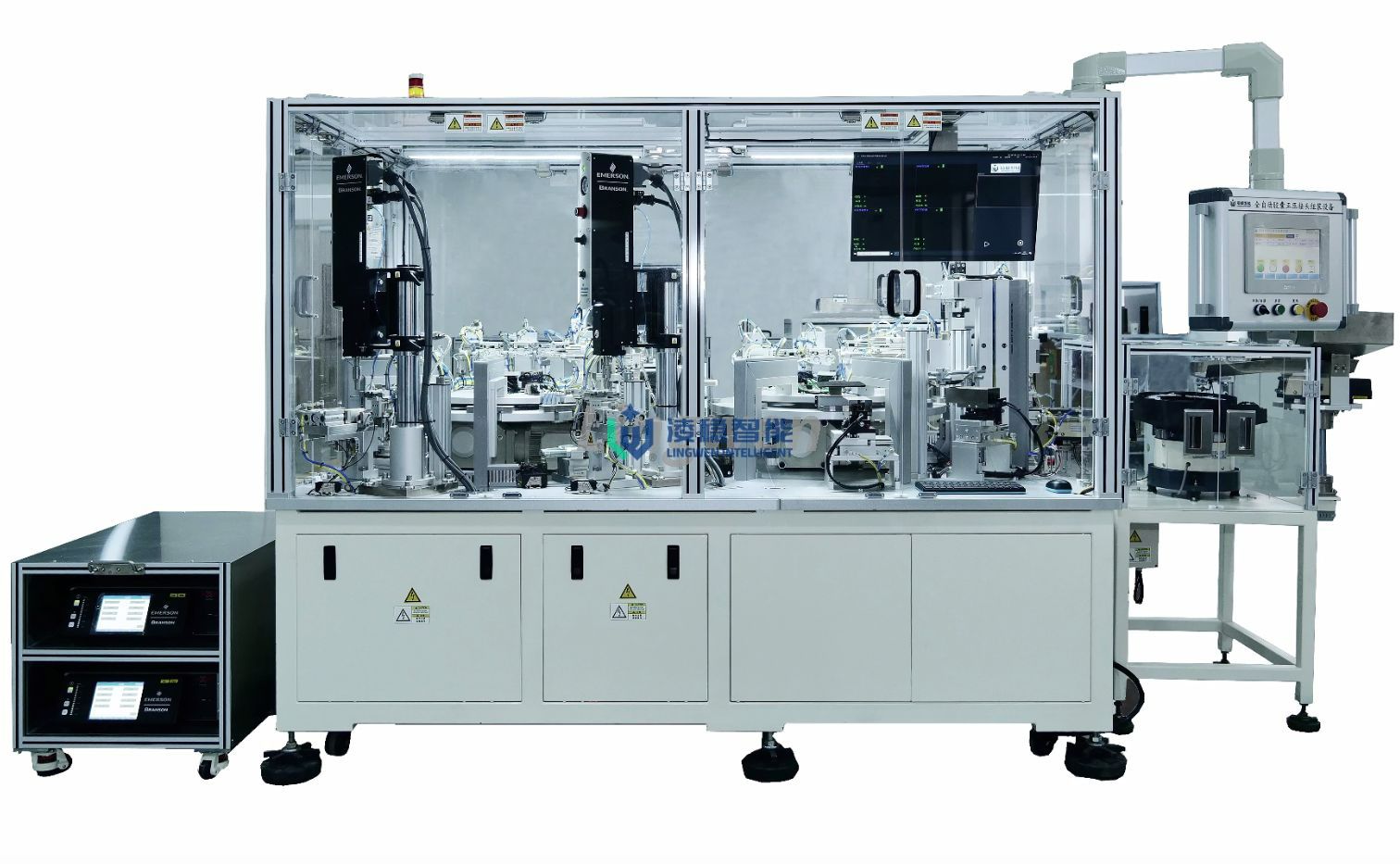
Defect prevention remains the highest priority in medical device manufacturing. Advanced assembly machinery incorporates inline vision inspection to catch errors instantly. High-resolution cameras inspect components at multiple stages. They operate at pixel-level accuracy. These vision systems detect housing defects, incorrect valve seating, or particulate contamination in real-time. If a camera spots a microscopic flaw, the machine automatically diverts the defective unit into a reject bin. This prevents bad parts from reaching the packaging phase.
Physical integrity requires rigorous verification. Automated pressure and leak decay testing provide this assurance. The machinery fills every single assembled connector utilizing compressed air. It then isolates the part and measures pressure drop over a specified timeframe. This 100% inline testing verifies the pneumatic and hydraulic integrity of the negative pressure seal. Devices failing this decay test immediately trigger an automatic rejection protocol.
Many facilities operate diversified production lines. They might deploy a Positive Needlefree Valve Assembly Machine or a Neutral Needle Free Valve Connector Machine alongside negative displacement equipment. Regardless of the specific displacement type, traceability remains legally mandatory. FDA 21 CFR Part 11 compliant software manages batch tracking and parameter logging. The system records the exact welding pressure, insertion force, and leak test results for every unit produced. It generates automated, tamper-proof audit trails. This digital documentation proves invaluable during routine FDA or ISO 13485 audits.
Installing automated manufacturing equipment involves significant logistical challenges. Cleanroom integration stands as the primary hurdle. Most medical device facilities operate ISO Class 7 or Class 8 cleanrooms. These controlled environments have strict physical footprint limitations. Engineering teams must carefully address exhaust management. They must filter any particulates generated during ultrasonic welding through HEPA systems. Pneumatic requirements also demand clean, oil-free compressed air to avoid contaminating the final product.
Production schedules suffer when machines require long changeover procedures. Facilities often switch between different product SKUs throughout the month. Changeover and tooling delays can cripple your daily output. You must conduct realistic assessments of planned downtime. Modern machines mitigate this risk using quick-release tooling mechanisms. Operators can swap fixtures rapidly without requiring specialized calibration tools. This modular approach keeps the line moving.
Even the most advanced robotics rely on human oversight. Operator adoption dictates long-term success. Facility managers must implement robust operator training programs. Preventative maintenance schedules are equally critical to prevent sudden breakdowns. Common maintenance tasks include:
Flushing pneumatic lines to clear built-up moisture or micro-debris.
Applying medical-grade lubrication to high-friction robotic joints.
Replacing ultrasonic welding horns based on exact cycle-count limits.
Recalibrating vision system lenses after aggressive cleanroom sterilization washdowns.
Handling wear-and-tear on high-friction components prevents unplanned downtime. Stocking critical spare parts onsite ensures technicians can resolve minor mechanical issues immediately. This proactive approach sustains high OEE metrics year after round.
Procuring capital equipment requires a structured evaluation framework. You must demand rigorous Factory Acceptance Testing (FAT) protocols before authorizing shipment. Do not settle for simple video demonstrations. Travel to the vendor facility. Demand extensive dry runs mirroring your actual cleanroom conditions. Track continuous operation metrics over a full shift. You should also mandate reject simulations. Intentionally introduce defective parts into the hopper. Verify the vision system catches and rejects every single flawed unit accurately.
Regulatory compliance demands comprehensive paperwork. You must verify validation documentation support early in the vendor selection process. Building a Positive Needlefree Valve Connector Assembly Machine or a negative displacement system requires the same rigorous proof. The vendor must provide comprehensive Installation Qualification (IQ), Operational Qualification (OQ), and Performance Qualification (PQ) documents. These documents prove the machinery operates exactly as intended under specified parameters. Without vendor-supplied IQ/OQ/PQ templates, your internal engineering team will waste months drafting them from scratch.
Vendors frequently highlight impressive OEE guarantees during sales pitches. You must vet these claims aggressively against manufacturing reality. Ask for references from similar clinical manufacturing settings. Investigate actual uptime data, realistic scrap rates, and actual sustained throughput. A machine promising 150 units per minute loses its value if it jams every two hours. Focus on continuous, stable output rather than theoretical maximum speeds.
Upgrading to advanced assembly lines represents much more than a simple capacity boost. It serves as a vital risk-mitigation tool for medical device manufacturers worldwide. Replacing manual inconsistencies with robotic precision ensures every negative displacement connector functions exactly as designed. This unwavering precise assembly directly impacts patient safety, reduces clinical complications, and protects your brand credibility in a highly regulated market.
Facilities continuing to rely on legacy methods face compounding risks regarding quality control and output limitations. We strongly recommend scheduling a technical consultation with an established automation vendor. You should request a customized OEE projection based entirely on your specific facility constraints and cleanroom classifications. Taking action now secures your competitive advantage and ensures compliance well into the future.
A: Fully automated machinery typically outputs between 60 and 150 units per minute. The exact speed depends heavily on the complexity of the internal valve design, the specific welding technology utilized, and the number of inline inspection stations the system must accommodate during the cycle.
A: Yes, many advanced platforms handle multiple variations. However, this requires modular, quick-change tooling. You will need different fixtures and customized programming recipes to accommodate the differing silicone valve geometries inherent to positive, neutral, and negative displacement mechanisms.
A: The machinery utilizes servo-driven robotic actuators featuring sensitive force-feedback technology. These actuators continuously monitor insertion pressure in real-time. If they detect excessive resistance indicating a potential tear or misalignment, the machine instantly halts the insertion and rejects the specific component.
A: These machines are specifically engineered for ISO Class 7 and ISO Class 8 cleanroom environments. They feature smooth, wipe-down compatible stainless steel surfaces. They also integrate targeted HEPA exhaust filtration to manage particulates generated during the ultrasonic plastic welding stages.
A: The entire validation process generally takes between four and twelve weeks. This timeline depends on facility readiness and the quality of the vendor-supplied documentation templates. Thorough FAT execution significantly accelerates the final onsite PQ phase.


