
- All
- Product Name
- Product Keyword
- Product Model
- Product Summary
- Product Description
- Multi Field Search
Views: 0 Author: Site Editor Publish Time: 2026-06-12 Origin: Site
Scaling up operations in the medical device sector demands highly specialized automation. When managing the production of life-saving renal care products, capital expenditure decisions must align perfectly with your specific fluid-path or vascular-access production logic. Manufacturers often struggle to weigh the differing automation complexities, footprint requirements, and validation costs. The technical gap between complex multi-component tubing systems and high-precision needle assemblies complicates these investment choices.
A misstep in equipment selection can lead to layout inefficiencies and severe regulatory delays. This guide breaks down the operational realities, compliance considerations, and risk factors of each system. We explore structural differences, quality control measures, and cleanroom integration techniques vital for robust hemodialysis consumables assembly. Reading this, production engineers and procurement leaders will learn how to make evidence-based equipment investments confidently.
Complexity vs. Precision: Bloodline tubing assembly demands multi-station integration for managing long, flexible materials and bonding logic, whereas AV fistula needle assembly prioritizes micro-precision handling, cannula orientation, and siliconization.
Footprint & Scalability: A typical dialysis bloodline machine requires a significantly larger cleanroom footprint due to the physical length of the sets and the numerous quality inspection stations (e.g., flow testing, leak testing).
Validation Overhead: Both machines require rigorous IQ/OQ/PQ validation, but AV needle systems face stricter scrutiny regarding sharp-handling safety guards and puncture-force consistency.
Investment Alignment: Choosing between (or integrating) these systems depends on your current market penetration—whether you are competing on high-volume standard tubing kits or specialized, safety-engineered vascular access products.
Understanding the production ecosystem requires defining the distinct clinical roles of the consumable components. The AV fistula needle serves as the critical vascular access point. It penetrates the patient's vein to draw and return blood safely. In contrast, the bloodline set functions as the extracorporeal circuit. It transports blood from the patient to the dialyzer and back, managing fluid dynamics along the way. Manufacturing these distinct components requires entirely different automation approaches.
Manual assembly no longer meets the rigorous demands of modern medical manufacturing. Rising labor costs and high turnover rates disrupt continuous operations. More importantly, manual handling introduces significant bioburden risks. Human operators naturally generate particulate matter, threatening the sterility of ISO 8 or higher cleanrooms. Batch-to-batch inconsistency also plagues manual production, leading to unacceptable rejection rates during regulatory audits. You must rely on advanced medical assembly equipment to eliminate these human variables.
Successful implementation of these automated systems depends on specific, measurable criteria. Production engineers evaluate machine performance through three primary metrics:
Yield Rates: The system must consistently produce defect-free products, minimizing scrap materials and maximizing raw component utilization.
Changeover Speed: Operators need to transition swiftly between different gauges or tube lengths. Agile tooling systems reduce costly machine downtime.
Compliance Data Logging: Modern equipment must capture verifiable production data. Traceability ensures every batch meets strict regulatory standards.
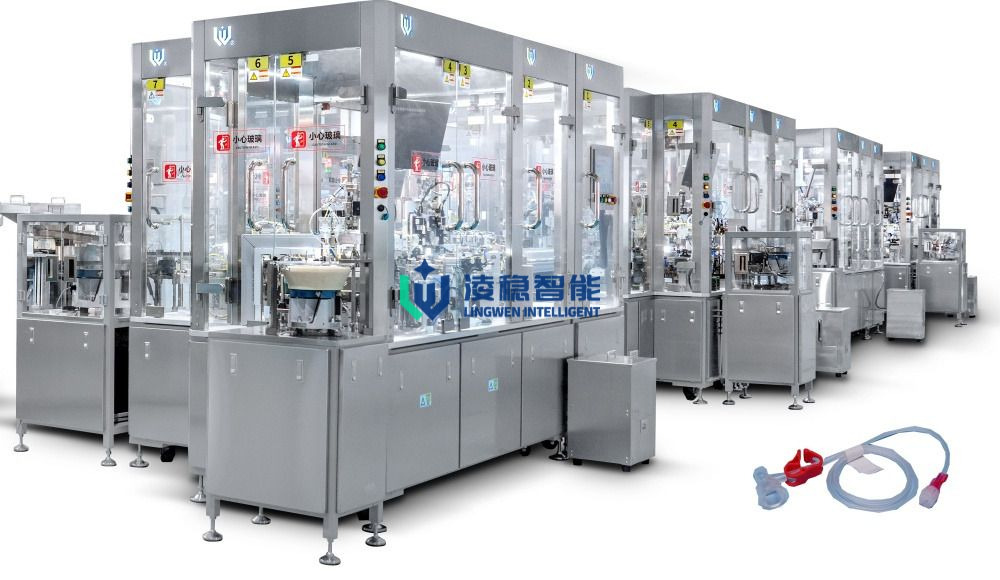
A specialized bloodline tubing assembly machine operates as a sprawling, multi-station network. Core functionality involves precise tube cutting, automatic coiling, and synchronized component feeding. The machine integrates drip chambers, color-coded clamps, and dialyzer connectors seamlessly. Because bloodlines consist of multiple interconnected fluid pathways, the automation logic must index these long, flexible materials rapidly without tangling.
Bonding technology forms the heart of tubing assembly. Manufacturers typically choose between solvent bonding and UV curing stations. Solvent bonding often utilizes cyclohexanone to fuse PVC components. This method requires robust localized exhaust ventilation (LEV) to maintain cleanroom air quality and protect operator health. Conversely, UV curing offers a cleaner, faster alternative for specific light-sensitive adhesives. UV systems eliminate hazardous vapor emissions but demand strict environmental controls to prevent premature adhesive curing inside the dispensing valves.
In-line quality control acts as the ultimate safeguard for fluid paths. You cannot rely on batch sampling when patient safety is at risk. Automated systems incorporate continuous leak testing and occlusion testing. High-speed vision systems verify component placement and joint integrity in milliseconds. These integrated checks guarantee zero defects reach the final packaging stage.
Managing material behavior presents the most significant operational challenge. Flexible PVC or DEHP-free tubing naturally resists uniform handling. The machine must grip, pull, and coil the tubing without causing kinks. Material stress during high-speed indexing can weaken the tubing walls, leading to micro-leaks. Engineers combat this by utilizing servo-driven tension controllers and gentle pneumatic grippers.
Best Practice: Always condition raw tubing in the cleanroom environment for 24 hours before assembly. This stabilizes the material's thermal properties, preventing dimensional shifts during cutting and bonding.
Common Mistake: Over-tightening pneumatic feed rollers. This deforms the tubing profile, resulting in unreliable solvent application and subsequent joint failures.
While tubing machines handle sprawling assemblies, needle automation focuses entirely on microscopic tolerances. The core functionality revolves around joining the stainless steel cannula, the color-coded butterfly wings, and the safety deployment hubs. The equipment indexes these tiny, rigid components through sequential press-fit and adhesive stations at high speeds.
Critical tolerances define the success of needle manufacturing. The exact orientation of the needle bevel dictates clinical usability. For example, during a 16G AVF needle assembly, even a fractional degree of misalignment causes severe patient discomfort and unnecessary tissue trauma. Automated vision systems must verify this bevel angle before the cannula locks into the plastic wing hub.
The siliconization process adds another layer of complexity. An automated AV fistula needle machine applies medical-grade silicone to the needle tip. This coating reduces penetration friction, enhancing patient comfort. However, the process demands precise micro-dosing. Overspray contaminates the bonding surfaces of the hub, leading to catastrophic assembly failures. Environmental controls must manage temperature and humidity to ensure the silicone cures uniformly.
Regulatory bodies increasingly demand advanced anti-needlestick mechanisms. Integrating these safety guards complicates the assembly process. Equipment must handle complex, multi-part safety hubs without damaging the delicate cannula. The automation logic verifies that the safety shield deploys smoothly and locks securely over the needle tip post-assembly.
Comparing these systems reveals stark contrasts in operational demands. You must align your facility layout and production goals with the specific characteristics of each machine class. A standard dialysis bloodline machine consumes significant cleanroom floor space. The physical length of the extracorporeal circuits necessitates long conveying systems and multiple bulky inspection stations. Conversely, needle assembly lines are compact but incredibly dense. They pack numerous micro-assembly modules into a localized footprint.
Changeover agility impacts your overall production efficiency directly. On a bloodline system, changeovers focus heavily on tooling swaps for pediatric versus adult lines. Operators must adjust tubing cutting lengths, swap drip chamber gripping jaws, and recalibrate flow testing parameters. For an AV needle system, changeovers revolve around swap-parts for different gauges, such as moving from a 14G to a 17G setup. This requires meticulous recalibration of the vision inspection systems to recognize different cannula diameters and color-coded wings.
Compliance data and traceability separate acceptable machines from exceptional ones. Both systems must handle CFR 21 Part 11 compliance rigorously. They track batch data, log rejected parts, and record parameter deviations. However, the data focus differs. Tubing systems monitor curing times, solvent dispensing volumes, and pressure drop during leak tests. Needle systems monitor cannula insertion force, bevel alignment angles, and safety guard deployment resistance.
| Metric | Bloodline Tubing Assembly | AV Fistula Needle Assembly |
|---|---|---|
| Cleanroom Footprint | Large / Sprawling | Compact / Dense |
| Primary Output Handling | Flexible, continuous indexing | Rigid, micro-precision indexing |
| Key Quality Checks | Leak, occlusion, bond strength | Bevel orientation, puncture force |
| Changeover Focus | Tube length, drip chamber size | Cannula gauge, vision calibration |
| Critical Data Tracked | Solvent volume / curing time | Insertion force / siliconization |
Procuring the equipment represents only the first step. Rollout success relies heavily on supply chain dependencies. The efficiency of either machine depends absolutely on the dimensional stability of your raw components. If your injection molding or extrusion partners deliver parts with varying tolerances, automated assembly will fail. Small plastic flashes on a drip chamber or microscopic bends in a raw cannula cause constant machine jams.
Validation timelines often surprise procurement teams. Factory Acceptance Testing (FAT) at the vendor site ensures basic mechanical function. However, Site Acceptance Testing (SAT) in your cleanroom presents entirely different challenges. You must set realistic expectations for IQ/OQ/PQ phases. Validating an AV needle machine's sharpness retention post-assembly requires lengthy biological and mechanical testing phases. Similarly, proving that solvent bonds on a tubing set consistently hold pressure takes weeks of rigorous data collection.
Operator training requires tailored approaches for each system. The troubleshooting skillsets contrast sharply. Tubing assembly jams usually stem from mechanical or material-handling issues. Operators learn to untangle lines, clean solvent dispensing nozzles, and adjust pneumatic tensions. Needle assembly errors, on the other hand, frequently involve micro-sensor calibration or delicate pneumatic timing. Technicians must understand fine-tuning vision system lighting and realigning micro-grippers.
Best Practice: Involve your lead maintenance technicians during the FAT phase at the manufacturer's facility. Hands-on experience before the machine ships reduces SAT troubleshooting delays drastically.
Common Mistake: Rushing the OQ (Operational Qualification) phase. Failing to test the equipment at the absolute limits of acceptable raw material tolerances guarantees unexpected downtime during full production.
Selecting the right automation path requires an honest evaluation of your current portfolio and infrastructure. If you plan to expand an existing consumables catalog, map your decision directly to your current injection molding capabilities. Facilities producing diverse plastic housings might naturally pivot toward bloodline assembly. Those with existing high-precision cannula grinding operations should leverage that expertise into automated needle assembly.
Capital expenditure demands careful financial modeling. Look far beyond the initial machine purchase price. You must factor in the cost of consumable change parts required for different product SKUs. Evaluate your current cleanroom capacity. Expanding an ISO 8 cleanroom to accommodate a sprawling tubing line requires massive HVAC and structural investments. You must also budget appropriately for preventive maintenance contracts and specialized spare parts inventories.
Your next steps for procurement must focus on clear communication with OEMs. Develop a standardized User Requirement Specification (URS) document. The URS serves as your technical blueprint. Ensure it explicitly demands Overall Equipment Effectiveness (OEE) guarantees under specific operational conditions. Outline your expectations for validation support, ensuring the vendor commits to assisting through the final PQ documentation phase.
Neither machine configuration is inherently superior. They solve fundamentally different mechanical challenges within the hemodialysis supply chain. Tubing assembly systems master the chaos of flexible material handling and fluid-path integrity. Needle assembly systems dominate the microscopic realm of sharp handling, bevel orientation, and patient safety.
We recommend prioritizing equipment OEMs that offer transparent Proof of Principle (PoP) testing. Require them to run your specific raw materials through custom test jigs before demanding a final design freeze. This mitigates the risk of catastrophic material handling failures.
Consult with an automation engineer to review your exact component drawings. By evaluating custom versus off-the-shelf assembly solutions, you can align your production layout perfectly with your clinical market goals.
A: No. The mechanical handling requirements—long, flexible tubing vs. rigid, micro-precision sharps—require dedicated, specialized production lines. Combining these entirely different automation logics into one frame is technically unfeasible and highly inefficient.
A: Depending on the OEM's use of quick-release tooling and servo-driven adjustments, standard changeovers typically range from 30 to 90 minutes. Systems utilizing recipe-driven HMI controls achieve the fastest changeovers by minimizing manual calibration.
A: High-end systems utilize closed-loop micro-dispensing valves with integrated localized exhaust ventilation (LEV). This critical extraction infrastructure continuously removes harmful chemical vapors, maintaining strict ISO cleanroom particle and vapor standards safely.
A: While technically optional on base models, vision systems are practically mandatory for ISO 13485 compliance. They instantly verify critical-to-quality attributes like needle bevel orientation or tubing insertion depth, guaranteeing patient safety without slowing production.


