
- All
- Product Name
- Product Keyword
- Product Model
- Product Summary
- Product Description
- Multi Field Search
Views: 0 Author: Site Editor Publish Time: 2026-05-29 Origin: Site
Hemodialysis bloodline production carries immense stakes in the medical device manufacturing sector. Extracorporeal circuits demand zero-defect manufacturing continuously. Any failure along the line can lead to severe clinical risks, including mechanical hemolysis, catastrophic air embolism, or life-threatening bloodstream infections. Manufacturers currently face a complex dual challenge. They must rapidly scale production capacities to meet the booming global demand for chronic kidney disease (CKD) treatments. Simultaneously, they must strictly control manual assembly variables and maintain rigid FDA and ISO regulatory compliance.
This guide provides production engineers and medical device procurement teams with a clear, evidence-based framework. You will learn how to strategically evaluate, shortlist, and implement a blood tubing assembly machine. The right equipment perfectly balances high-volume yield rates against uncompromising, clinical-grade reliability. By understanding the mechanical translation of clinical requirements, your team can deploy automation that secures both patient safety and operational excellence.
Clinical-Grade Precision: The right machine must guarantee exacting tolerances, particularly in the blood pump segment, to prevent mechanical red blood cell damage (hemolysis).
Sub-Assembly Automation: ROI is driven by the equipment's ability to seamlessly integrate complex sub-assemblies, including drip chambers, heparin lines, and transducer protectors.
Inline QA is Mandatory: Viable hemodialysis bloodline machines must feature integrated pressure and leak testing (meeting FDA 1.5x maximum pressure thresholds) to eliminate downstream quarantine risks.
Validation & Rollout: Equipment selection must factor in supplier support for IQ/OQ/PQ validation and adaptability to varying tubing materials (e.g., DEHP-free PVC, kink-resistant polymers).
Clinical instructions for use (IFUs) directly dictate modern machine engineering. A production line does not simply cut plastic tubes and glue them together. It builds a life-critical fluid path. Every joint, seam, and seal must withstand extreme clinical pressures. During standard dialysis therapy, arterial and venous pressures often fluctuate between extremes of -300 mmHg and +500 mmHg. FDA 510(k) guidance mandates strict performance testing to validate these limits. Your manufacturing equipment must translate these intense clinical demands into precise mechanical reality.
Automated systems mitigate the top three FDA-identified health risks highly effectively:
Hemolysis Prevention: The system must cut and bond the blood pump segment perfectly. Near-zero tolerance deviation is absolutely essential. If tubing fits slightly too tight or too loose inside a dialysis machine's rotary pump, mechanical blood trauma occurs rapidly. Automated servo-driven grippers guarantee consistent dimensional accuracy across millions of cycles.
Air Embolism Prevention: Automated bonding and gluing stations ensure airtight connections. They secure Luer locks, Y-injection sites, and access ports flawlessly. A robust machine applies precise micro-doses of solvent or UV-curable adhesives to eliminate invisible micro-leaks.
Infection Control: Production systems must support ISO Class 7 or 8 cleanroom environments. They must handle materials compatible with primary sterilization methods like ETO, Steam, or Gamma irradiation. The automated assembly process cannot degrade joint integrity, ensuring the fluid path remains sterile post-packaging.
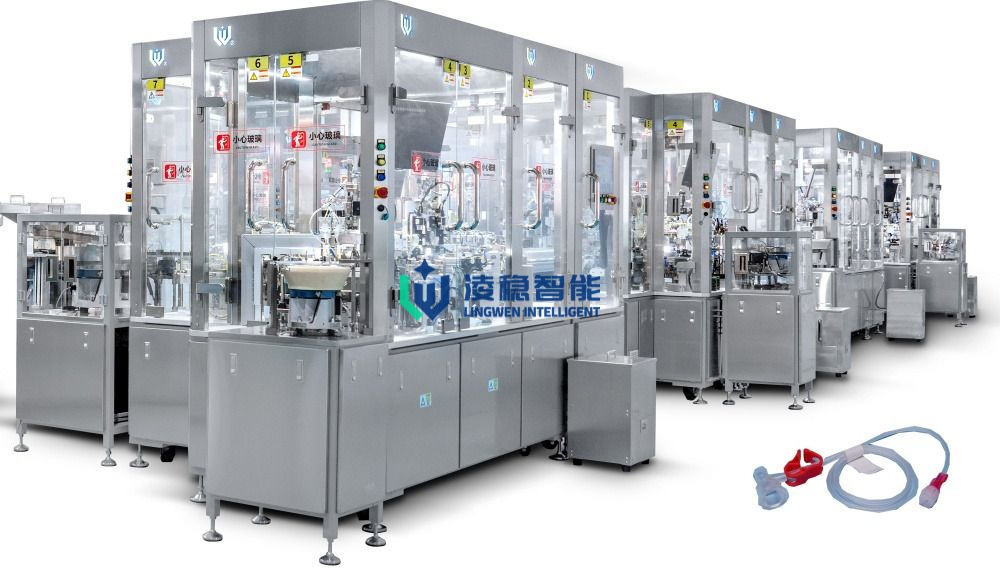
A true end-to-end manufacturing system minimizes human touchpoints across the most complex components of the extracorporeal circuit. You need a dialysis tubing assembly machine capable of mastering delicate, multi-stage sub-assemblies without slowing down the primary indexing dial.
The Arterial and Venous Drip Chambers (Bubble Traps)
Drip chambers require flawless multi-part robotic assembly. The machine must join the rigid chamber body, the delicate internal filter, and the top cap seamlessly. It cannot compromise the critical air-blood interface design. Any misalignment during the pressing phase alters internal fluid dynamics. This increases the risk of trapped air micro-bubbles escaping into the venous return line, threatening patient safety.
Transducer Protectors (TP)
You must carefully assess how the equipment handles highly sensitive filter materials. Transducer protectors isolate the dialysis machine's internal pressure sensors from patient blood. The assembly module must securely bond 0.2μm PTFE hydrophobic membranes. These filters typically feature a 2.5 cm² effective filtration area. The machine must perform this ultrasonic or thermal bonding without causing heat degradation or mechanical tearing. Achieving 100% isolation ensures absolute patient safety against viral cross-contamination.
Service & Heparin Lines
Look for sophisticated modular feeding systems. They must accurately cut, coil, and band smaller integrated lines. A top-tier hemodialysis bloodline machine attaches manual clamps smoothly without scoring the tubing surface. It also secures needleless or split-septum injection sites automatically. This precision automation entirely eliminates the high scrap rates typically associated with manual clamping and hand-gluing operations.
Evaluating specialized equipment requires looking far beyond basic speed metrics. You must measure how well the machinery adapts to modern biocompatible materials and dynamic factory workflows. True operational excellence stems from consistent yield rather than theoretical peak velocity.
Throughput vs. Footprint (Yield Metrics)
Calculating true Overall Equipment Effectiveness (OEE) dictates your production success. Do not just look at raw "parts per minute" claims found in brochures. Factor in expected scrap rates, changeover downtime, and routine calibration pauses. High-speed lines only hold value if product yield quality remains near 100%. A slower machine with zero defects outpaces a faster machine that generates excessive rework.
Below is a diagnostic chart comparing evaluation metrics for advanced medical tubing assembly:
| Evaluation Metric | Standard Manual Expectation | Advanced Automation Standard |
|---|---|---|
| OEE Target Level | 65% - 70% | > 85% (driven by minimal scrap) |
| Average Scrap Rate | 3% - 5% | < 1% |
| Tooling Changeover Time | > 3 hours | < 45 minutes via modular racks |
| Direct Labor Requirement | 6 - 10 operators per shift | 1 - 2 operators (supervision only) |
Material Agnosticism
The medical industry is shifting rapidly toward standardized, highly biocompatible materials. Your equipment must process varying degrees of tubing flexibility effortlessly. It should seamlessly handle kink-resistant polymers, non-toxic alternatives, and DEHP-free PVC. Adjusting feed tracks, tensioners, and bonding temperatures for latex-free injection sites must be a straightforward software adjustment, not a mechanical overhaul.
Changeover and Tooling Flexibility
Flexible production lines adjust rapidly to changing purchase orders. Consider how fast operators can toggle the setup between Pre-Pump and Post-Pump circuit configurations. Evaluate the actual time required to swap tooling nests for different drip chamber shapes. Some regional markets demand straight hard chambers, while others require conical soft chambers. Rapid tooling swap capabilities keep your bloodline tubing production schedules highly agile and intact.
Operator Ergonomics and Safety
Automated material loading provides massive workplace safety benefits. It dramatically reduces repetitive strain injuries (RSI) common in traditional manual assembly environments. Furthermore, automated needle, spike, and Luer insertions eliminate accidental needle-stick risks for your workforce entirely. Protecting your workers translates directly to smoother daily operations.
Identifying a fluid leak at the final packaging stage is disastrous for manufacturers. In automated assembly lines, delayed defect discovery leads to massive batch quarantines and wasted materials. Integrated inline testing at individual assembly stations prevents this scenario completely.
Tensile Strength & Bonding Verification
Inline pull-testing guarantees that tubing joints meet strict mechanical stress requirements. The FDA demands verification of all connected segments. Automated pneumatic actuators apply a calibrated pulling force to fresh joints. This mechanism confirms that solvent welds or UV bonds hold fast against the pulling and twisting typical of clinical handling.
Pneumatic Leak Testing
Advanced machinery must feature inline pressure decay testing. It must simulate demanding FDA and ISO thresholds reliably. For example, testing modules must hold 1.5x the labeled positive and negative clinical pressures for specific durations. Transducer protectors require rigorous 2x pressure strikethrough tests. Immediate pneumatic feedback allows the central PLC to eject single defective units automatically without stopping the entire line.
Vision Systems
High-speed optical cameras act as infallible digital quality inspectors. They verify the correct color-coding of lines instantly. The global industry standard strictly uses Red for arterial pathways and Blue for venous pathways. Vision systems also confirm the physical presence of crucial internal O-rings. They check the exact orientation of flow diverters inside needle guard assemblies. This guarantees zero anatomical mix-ups occur in the dialysis clinic.
Deploying a complex medical manufacturing line presents specific rollout challenges. Careful planning and vendor scrutiny mitigate these implementation hurdles effectively.
The Validation Bottleneck (IQ/OQ/PQ)
An advanced machine only performs as well as its validation package allows. FDA and ISO regulatory auditors require exhaustive proof of mechanical consistency. Assess the vendor’s documentation quality early in the procurement phase. They must provide robust, customizable protocols for Installation Qualification (IQ), Operational Qualification (OQ), and Performance Qualification (PQ). Lacking these fundamental documents delays commercialization by several months.
Customization vs. Standard Platforms
Buyers must weigh standard off-the-shelf equipment against highly customized modular platforms. Standard platforms usually offer faster delivery times. However, custom-engineered modular machines adapt much better to proprietary tubing sets. They also scale easily when your product designs evolve, allowing you to add new robotic stations rather than buying entirely new chassis.
Shortlisting Next Steps
Follow these practical, action-oriented steps when shortlisting your potential vendor partners:
Request Proof-of-Principle (PoP) Testing: Demand physical testing of your most complex joints on their lab equipment before committing.
Send Raw Materials: Ship your specific DEHP-free or kink-resistant tubing samples to the manufacturer for live feed-track validation.
Audit the Facility: Visit the vendor directly to inspect their manufacturing practices, machining tolerances, and software integration capabilities.
Review Validation Templates: Ask to see redacted IQ/OQ/PQ documents from their previous medical device installations.
Choosing the right assembly equipment represents a vital strategic decision. It successfully bridges the gap between high-volume commercial production targets and unforgiving clinical safety margins. A well-engineered line protects both vulnerable dialysis patients and your institutional brand reputation.
To ensure a successful deployment, prioritize vendors offering integrated vision and pneumatic inline QA systems natively. Demand comprehensive IQ/OQ/PQ validation support upfront to avoid costly rollout delays. Select modular tooling systems capable of adapting to emerging biocompatible materials, ensuring your production line remains relevant for decades. Finally, always execute rigorous proof-of-principle testing on your most difficult sub-assemblies before signing any final contracts.
A: Extreme precision is absolutely vital for this segment. Tolerances often fall within a fraction of a millimeter. Perfect sizing prevents pump occlusion errors during therapy. If the assembled tube is too tight, it causes severe mechanical hemolysis, destroying red blood cells and directly threatening patient safety.
A: Yes. Modern assembly systems process DEHP-free materials efficiently. However, they require specific feed-track adjustments. DEHP-free PVC features different surface friction and thermal bonding properties compared to standard PVC, demanding precise calibration of solvent dispensers and UV curing stations.
A: Machines utilize sophisticated inline pressure differential decay testing. They apply strict pneumatic pressure directly to the sub-assembly. This ensures the 0.2μm PTFE hydrophobic membrane sits correctly. It verifies the seal remains entirely leak-proof, even under extreme clinical pressure variations.
A: Timelines vary significantly based on complexity, generally ranging from 6 to 12 months. This schedule accounts for initial mechanical design, rigorous Factory Acceptance Testing (FAT), international shipping logistics, Site Acceptance Testing (SAT), and final regulatory validation procedures.


