
- All
- Product Name
- Product Keyword
- Product Model
- Product Summary
- Product Description
- Multi Field Search
Views: 0 Author: Site Editor Publish Time: 2026-06-05 Origin: Site
Dialysis consumables manufacturing currently faces unprecedented pressure. Surging global demand requires massive volume output to sustain healthcare systems. At the same time, shrinking profit margins and increasingly stringent regulatory scrutiny severely squeeze your operational flexibility. Manufacturers can no longer rely on outdated manual processes to meet these rigorous industry demands. You need a robust, scalable solution to stay competitive. This makes automated bloodline tubing assembly a critical transition. Upgrading allows you to scale operations far beyond the physical limitations of manual or semi-automated setups. In this guide, we evaluate the comprehensive impacts of adopting a fully automated system. We explore the profound operational improvements, financial benefits, and strict compliance alignments you can expect. You will also learn how to navigate realistic implementation challenges. By the end, you will understand exactly how modernizing your production line secures your position in the medical device sector.
Capacity Scaling: Automation stabilizes throughput (UPH) and reduces reliance on variable labor in cleanroom environments.
Defect Mitigation: In-line integration of a CCD inspection bloodline system and automated leak testing dramatically lowers scrap rates and recall risks.
Compliance Alignment: Automated data logging and consistent solvent dispensing support stricter CE, FDA, and ISO 13485 validation requirements.
ROI Timeline: Upfront CapEx is offset by labor savings, footprint optimization, and higher Overall Equipment Effectiveness (OEE) over a 24- to 36-month horizon.
Hiring, training, and retaining cleanroom personnel remains incredibly difficult today. Medical device assembly requires strict gowning protocols and sterile behavior. Many workers dislike these restrictive environments. This dissatisfaction drives exceptionally high turnover rates. Furthermore, manual assembly requires highly repetitive motions. Operators experience significant fatigue during long shifts. This physical fatigue heavily impacts cycle times and destroys output reliability. You cannot accurately forecast monthly yields when human fatigue dictates your daily throughput.
Manual solvent application rarely yields identical results across different operators. Hand-joining components and manual tubing coiling create massive standard deviations in product quality. Some operators apply excessive solvent pressure. This forces excess glue into the fluid path, creating dangerous internal blockages. Other operators apply insufficient solvent. This directly causes micro-leaks during clinical dialysis sessions. These human-driven variations guarantee high scrap rates. They also expose your brand to severe recall risks in the field.
Every human touchpoint elevates bioburden on medical plastics. Humans constantly shed microscopic particles, even inside advanced cleanroom suits. Particulate contamination spikes when operators handle unprotected PVC tubing manually. This reality greatly complicates your downstream sterilization protocols. If bioburden levels exceed acceptable limits, entire batches fail quality assurance checks. Reducing human intervention is the only definitive way to lower these contamination risks and ensure compliance.
Adding more headcount yields diminishing returns rapidly. Extra workers demand expanded cleanroom infrastructure. Expanding an ISO Class 7 or Class 8 cleanroom costs a massive premium per square meter. You also must scale up HR management, gowning supplies, and supervisor layers. A traditional blood tubing production line simply hits a hard scalability ceiling. You eventually run out of physical space to put more operators.
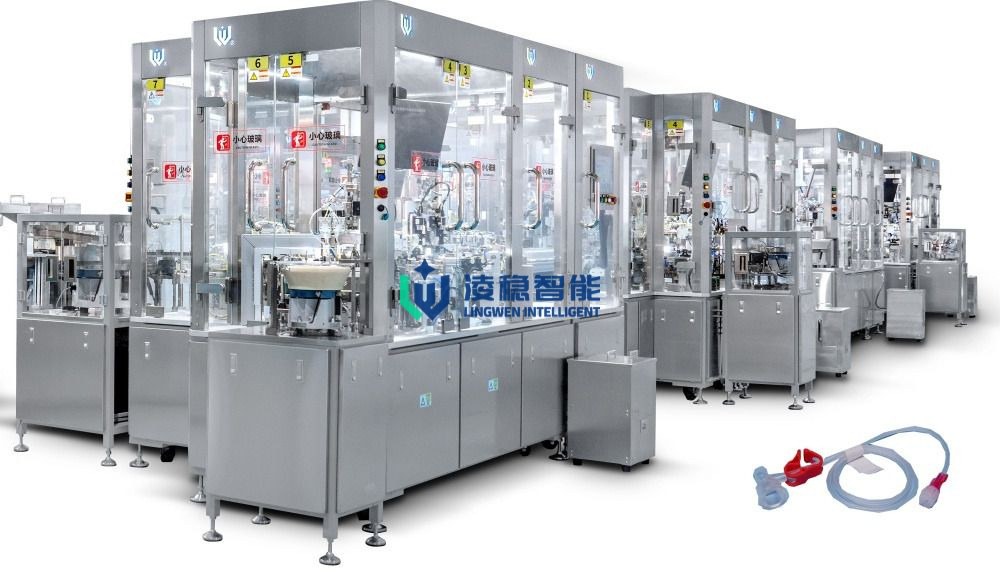
Transitioning from variable manual output transforms your facility's capabilities. You achieve highly predictable, continuous-motion or indexing production rates. dialysis bloodline automation guarantees reliable units per hour (UPH) regardless of shift changes. Continuous-motion systems excel at high-volume, single-SKU runs. Indexing systems offer slightly lower speeds but provide the agility needed for frequent product changeovers. Both architectures stabilize your supply chain immediately.
Controlled dispensing systems act with absolute precision. High-end automated lines utilize positive displacement pumps to apply exact microliter volumes of cyclohexanone or UV curatives. They eliminate excess gluing entirely. They also guarantee complete 360-degree joint coverage. This precision completely stops dangerous leaks and prevents internal blockages. Furthermore, automated curing tunnels ensure the bond achieves maximum tensile strength before the next assembly step occurs.
Feeding, cutting, and coiling medical-grade materials require extreme mechanical finesse. Traditional machines often stretch or scratch soft polymers. Modern systems address these complexities gracefully. They handle standard PVC or advanced DEHP-free materials flawlessly. Servo-driven tension control systems prevent kinks during rapid unspooling. Specialized gripper jaws eliminate material stress entirely, preserving the structural integrity of the tubing.
A unified hemodialysis tubing machine consolidates multiple manual workstations into one sleek frame. It creates a highly compact, cleanroom-optimized footprint. This consolidation saves expensive floor space and maximizes your revenue yield per square meter.
Predictable UPH: Run precise production schedules without factoring in human break times.
Zero-Defect Bonding: Automated dispensing standardizes joint integrity across millions of units.
Stress-Free Handling: Servo controls protect delicate medical polymers from stretching.
Maximized Space: Replace large assembly benches with unified machine enclosures.
Best Practice: Always request material feasibility tests before purchasing equipment. Send your exact PVC formulations to the automation vendor. They must prove their grippers can handle your specific material without leaving indentation marks.
You must deploy high-speed cameras to verify quality at the source. A robust CCD inspection bloodline setup verifies component orientation instantly. It checks for hidden particulate matter inside the drip chamber. It also validates glue line integrity in real-time. Sophisticated algorithms map the exact dimensions of every joint. If a connector sits even one millimeter out of alignment, the system flags it immediately.
Incorporate automated pressure and vacuum decay testing directly into the assembly flow. This integration guarantees total fluid path integrity without destroying the product. The machine injects sterile air into the assembled line. Highly sensitive pressure transducers monitor the internal environment for micro-pressure drops. A drop indicates a microscopic leak. The system rejects these units instantly, ensuring only perfect sets reach packaging.
Smart automation sorts defective units without halting the main production line. Diverter gates push bad parts into secured scrap bins autonomously. However, you must calibrate vision systems perfectly. Improper calibration triggers false-reject bottlenecks. If the cameras are too sensitive, they reject acceptable products, destroying your daily yield. Proper light tuning and algorithm adjustment solve this issue.
Automated serialization guarantees perfect batch reporting. Modern controllers log the exact test parameters of every single unit. They record the pressure decay curve, the vision system timestamp, and the solvent dispense volume. This data securely satisfies rigorous auditing requirements for medical devices. When an FDA or CE auditor requests a batch history, you can generate a comprehensive digital report instantly.
| Criterion | Manual Inspection | Automated Vision/Leak Testing |
|---|---|---|
| Speed | Slow; causes major bottlenecks. | Real-time; matches machine UPH perfectly. |
| Consistency | Highly variable due to eye strain. | 100% objective; never fatigues. |
| Data Logging | Paper-based; prone to human error. | Fully digital; complies with ISO 13485. |
| Defect Resolution | Found late in process; high scrap cost. | Found instantly; prevents further assembly. |
Weigh off-the-shelf turnkey systems against custom-engineered lines carefully. Your choice depends entirely on your product portfolio diversity. Off-the-shelf platforms offer faster delivery times and proven reliability. However, custom lines adapt better to proprietary dialyzer connectors or unique drip chamber shapes. Adult and pediatric lines often demand different setups. Assess your long-term product roadmap before committing to a rigid architecture.
Evaluate the exact time required to switch tooling. You will routinely switch between different tubing diameters, drip chamber sizes, or connector types. Quick-change tooling systems minimize costly machine downtime. Look for equipment utilizing tool-less changeover mechanisms or magnetic mounting plates. A changeover taking four hours destroys your OEE. A changeover taking twenty minutes keeps your facility highly profitable.
Feeding and gripping mechanisms must handle advanced materials seamlessly. The industry is rapidly shifting toward DEHP-free PVC, polyurethane, and silicone. These softer, sticky materials require highly specialized handling. Standard vibratory feeding bowls will jam. Ensure the machine utilizes specialized bowl coatings and optimized vibration frequencies to feed soft polymers reliably.
Assess the manufacturer's true track record. Expertise in medical consumables automation matters immensely. Medical device assembly requires strict adherence to sanitary design principles. Prioritize vendors offering strong preventative maintenance support and rapid spare parts availability.
Proven experience integrating advanced CCD vision software.
Demonstrated capability in validating medical-grade equipment (IQ/OQ/PQ support).
Global network for rapid spare parts dispatch.
Comprehensive training programs for your internal maintenance teams.
Common Mistake: Purchasing a system based solely on peak speed. A machine running at extremely high speeds but requiring excessive downtime for minor jams will ultimately deliver lower daily yields than a slightly slower, more reliable system.
You must acknowledge realistic validation timeframes. You cannot simply plug in a medical assembly machine and start selling products. Proper Installation Qualification (IQ) ensures all utilities and dimensions meet specifications. Operational Qualification (OQ) tests the machine across all functional ranges and limit conditions. Performance Qualification (PQ) runs continuous commercial batches to prove long-term stability. This rigorous testing phase usually takes several months. Plan your production schedules accordingly to avoid stock shortages.
Move beyond the initial purchase price when calculating your return on investment. Evaluate the long-term energy consumption of the proposed system. High-efficiency servo motors consume significantly less electricity than legacy pneumatic cylinders. Calculate your required pneumatic air usage (CFM). Generating cleanroom-grade compressed air costs money. Factor in expected maintenance downtime and replacement part costs. A higher upfront CapEx often yields better financial returns if the machine drastically lowers your daily energy and air consumption rates.
Factory Acceptance Testing (FAT) and Site Acceptance Testing (SAT) serve as critical milestones. They actively de-risk your substantial investment. During the FAT, you visit the vendor's facility to run your specific materials on the finished machine. Ensure the equipment hits targeted OEE before it ever leaves the vendor's floor. Catching software bugs or mechanical jams during FAT saves weeks of frustration. The SAT repeats these tests in your actual cleanroom to verify nothing broke during shipping.
You must upskill your existing line operators into capable machine technicians. Automation does not eliminate the human element; it elevates it. Technicians will learn to handle minor faults, refill solvent reservoirs, and execute essential preventative maintenance. Develop a comprehensive internal training program. Partner with your automation vendor to certify your top operators. This transition boosts employee morale and ensures your machine runs efficiently across all shifts.
Adopting advanced automated assembly processes is not merely a capacity play for ambitious manufacturers. It represents a mandatory quality baseline for competing globally. High-volume buyers demand zero-defect products and absolute traceability. Manual production simply cannot provide these guarantees anymore. Begin your transition immediately. First, map out your current process bottlenecks clearly to identify where human error costs you the most. Next, define your required UPH targets based on realistic market demand forecasts. Finally, initiate technical consultations with experienced automation vendors. Take these actionable steps today to secure your manufacturing future, eliminate scrap, and protect your brand reputation.
A: Industry standards dictate that highly optimized systems handle between 600 and 1,200 units per hour. Continuous-motion architectures generally achieve the higher end of this spectrum. Indexing systems operate slightly slower but offer easier changeovers for diverse product portfolios. Your specific UPH depends heavily on component complexity and material behavior.
A: Yes, modern automation handles DEHP-free materials efficiently. However, these sticky and soft alternatives require specialized engineering. Tooling and feeding bowl configurations must be specifically engineered with non-stick coatings to prevent material deformation. Proper surface treatments on gripper jaws ensure smooth manipulation without causing material stress.
A: Transparent medical plastics pose unique challenges for standard optical sensors. Advanced systems utilize sophisticated backlighting techniques to illuminate clear components perfectly. They deploy specialized algorithms designed to detect subtle light refractions. This setup successfully identifies microscopic defects, misalignments, or dangerous particulate matter hidden inside clear tubing.
A: Medical device manufacturers typically operate these automated systems within ISO Class 7 or ISO Class 8 cleanrooms. The machine's structural design must support this highly controlled environment. Engineers specifically design the machine's exhaust systems and pneumatics to meet strict airborne particulate standards, actively preventing micro-contamination.


