
- All
- Product Name
- Product Keyword
- Product Model
- Product Summary
- Product Description
- Multi Field Search
Views: 0 Author: Site Editor Publish Time: 2026-06-19 Origin: Site
In hemodialysis consumable manufacturing, the margin for error is absolutely zero. Clinical complications like catheter-related bloodstream infections (CRBSI), hemolysis, and thrombosis tie directly to microscopic defects in tubing inner walls, Luer lock integrity, and tip geometry. To meet strict CE and ISO standards alongside evolving clinical demands, medical device manufacturers must rely on highly specialized production equipment. They need systems capable of processing non-DEHP PVC and optimizing air-blood interfaces without compromise. Evaluating a new equipment line requires looking beyond basic output speeds alone. It demands a thorough assessment of how the machinery guarantees biocompatibility, fluid dynamic precision, and verifiable cleanroom compliance. We will explore the critical intersections between clinical hemodynamics and manufacturing tolerances. You will learn how modern automated assembly systems mitigate production risks and elevate patient safety.
Clinical-to-Manufacturing Alignment: High-end catheter machines are engineered to produce specific clinical geometries, such as symmetric tips that lower blood recirculation rates.
Precision Assembly is Non-Negotiable: Automated hemodialysis catheter assembly lines eliminate human error in attaching critical components like transducer protectors and needleless sampling ports.
Material Handling Versatility: Modern equipment must process kink-resistant, non-DEHP PVC and TPU without causing thermal degradation or micro-abrasions on the lumen's inner wall.
Scalability & Validation: The right machinery supports rigorous IQ/OQ/PQ validation processes required for regulatory compliance in Class II/III medical device production.
Dialysis centers prioritize consumables engineered to prevent clotting cascades. They also demand stable transmembrane pressure (TMP) during patient treatments. Poorly manufactured bloodlines often trigger frustrating machine alarms. These tiny manufacturing defects increase clinical heparin use and directly risk patient safety. Equipment buyers must address these clinical challenges at the factory level.
The hemodynamics of manufacturing play a massive role here. Consider inner wall smoothness first. Extrusion and assembly processes must guarantee zero dead space. This physical precision prevents turbulent blood flow. By eliminating turbulence, we stop premature platelet activation. Next, consider complex chamber geometry. Advanced clinical designs often feature variable-diameter arterial chambers. These specific chambers reduce harmful air-blood contact. Consequently, production machines must mold and seal complex, non-standard shapes flawlessly.
Success criteria for manufacturers depend heavily on equipment capabilities. We recommend evaluating your factory upgrades based on three specific pillars:
100% Inline Quality Control (QC): Equipment must test for microscopic leaks dynamically. Every joint requires verification before packaging.
Dimensional Precision: Tubing dimensions must remain uniform across thousands of meters. This consistency ensures stable fluid dynamics for the patient.
Cleanroom Compatibility: Operations must align perfectly with strict ISO classification standards. Pneumatic exhausts must not introduce particulates.
Manufacturers rely on a straight catheter machine to produce reliable short-term and standard access lines. The machinery must guarantee strict dimensional tolerance along the entire shaft. This extreme accuracy prevents fibrin sheath formation. Clinicians often call this the dangerous "one-way valve" effect. If the catheter lumen collapses slightly during cutting, blood flow stagnates and clots form rapidly.
Conversely, a curved catheter machine is essential for producing jugular and subclavian access catheters. The machinery applies highly controlled thermal forming. It sets the clinical curve without compromising the lumen's critical cross-sectional area. The cooling process must activate immediately to lock the polymer structure in place.
Engineers evaluate tip geometry capabilities rigorously. They test the system's ability to consistently form symmetric versus stepped tips. A symmetric tip significantly lowers the clinical recirculation rate. Lower recirculation directly improves dialysis adequacy for the patient.
Automated lines handle the complex integration of dual-lumen or multi-lumen tubing. They connect these delicate tubes seamlessly to extension lines and rotatable hubs. A dedicated hemodialysis catheter assembly system eliminates human inconsistency here. Manual assembly often leads to uneven solvent application or skewed Luer connections. Automation ensures every hub withstands high torque.
Many modern lines also apply specialized anti-microbial coatings. Some inject antimicrobial locking solutions directly into the ports at the manufacturing stage. This proactive manufacturing step reduces the risk of long-term patient infections. It also adds immense market value to the final medical device.
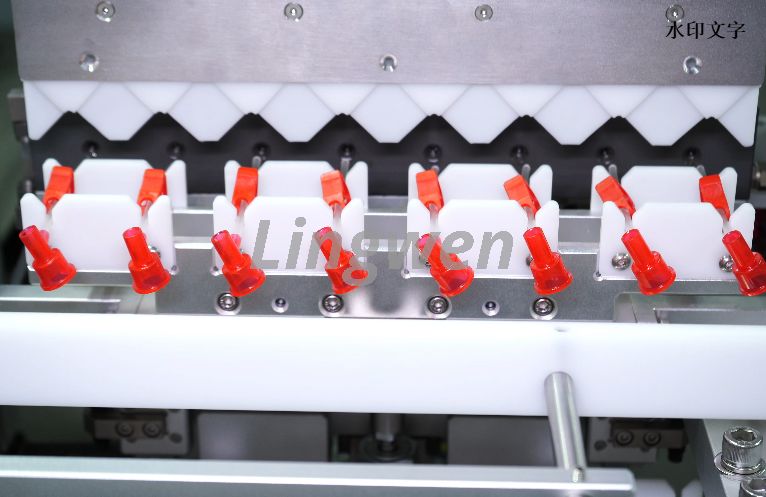
Automated systems insert and seal filter meshes precisely inside the drip chamber. These meshes act as vital degassing traps. They prevent catastrophic air embolism during clinical use. If a machine misaligns a single mesh, air bubbles can escape into the venous return line. Precision robotics guarantee exact seating.
Machines also handle the precision attachment of large finger guards. These specific guards protect nurses from accidental needle-stick injuries during intense clinical shifts. Furthermore, the equipment bonds Luer tapers tightly. This vital step ensures hermetic seals. These seals must withstand extremely high negative arterial pressures without aspirating room air.
The primary role of a bloodline collection machine is to automatically coil long segments of pump tubing. It must achieve this feat without inducing mechanical stress, bending memory, or dangerous micro-kinks. Medical-grade polymer remembers how you bend it. If wound too tightly, the tube collapses during clinical treatment.
These collection systems integrate closely with advanced vision inspection technologies. High-speed cameras verify the correct placement of color-coded clips. Red indicates arterial flow, while blue denotes venous return. The cameras also confirm exact sample port placements before passing the set to final blister packaging.
Material compatibility dictates your factory's future flexibility. Can the equipment transition seamlessly between standard PVC, Non-DEHP PVC, and long-term TPU materials? Doing so without excessive downtime or tool wear is a crucial operational advantage. TPU requires different heating profiles compared to traditional PVC.
Relying solely on batch testing is completely obsolete in modern medical manufacturing. High-end equipment must feature inline pressure decay testing. Optical sensors must verify component placement instantly. For example, they ensure transducer protectors sit perfectly flat before ultrasonic sealing begins. If a protector skews, the machine must reject the individual part automatically.
High throughput numbers mean nothing if your final scrap rate remains high. You should evaluate the hemodialysis catheter machine based on its defect-free true yield. Pay special attention to delicate joining points where leaks commonly occur. A machine running at 99% true yield beats a faster machine running at 90% yield every time.
Regulatory documentation support is another critical decision factor. Does the OEM provide comprehensive technical documentation? You need robust validation data to support CE/ISO audits. You also need this data for FDA 510(k) submissions. Without OEM support, validation delays will stall your product launch.
| Assessment Category | Minimum Market Requirement | Ideal High-End Capability |
|---|---|---|
| Material Processing | Standard PVC compatibility | Seamless transition to Non-DEHP and TPU |
| Quality Assurance | End-of-line batch sampling | 100% inline pressure decay and vision checks |
| Production Yield | Basic unit-per-minute speed metrics | Defect-free true yield tracking per shift |
| Component Bonding | Manual solvent application | Automated ultrasonic or precise UV curing |
Cleanroom integration presents immediate physical risks. You must consider heat generation and particulate shedding from pneumatic cylinders. The total machine footprint must align strictly with ISO Class 7 or Class 8 cleanroom constraints. Even minor oil mist emissions from factory air lines can ruin an entire sterile batch.
Complex bloodline sets require frequent tooling changes. You might produce batches for different dialyzer compatibilities in a single week. You must standardize across Fresenius, Baxter, or Nikkiso specifications rapidly. Assess the machine's SMED (Single-Minute Exchange of Dies) capabilities thoroughly. If a changeover takes four hours, your factory loses half a shift of productive output.
Rushing the equipment setup process leads directly to costly compliance failures. You must plan for three to six months of rigorous validation. Setting up reliable dialysis catheter production demands strict protocols. You must complete Installation Qualification (IQ), Operational Qualification (OQ), and Performance Qualification (PQ). Only after passing these demanding stages should commercial production begin. Skipping validation steps guarantees audit failures and product recalls.
Evaluating production equipment requires a deep understanding of clinical end-user needs. You must prioritize features preventing hemolysis, air embolisms, and thrombosis.
Shortlisting Logic: Base your equipment shortlisting logic on clinical alignment rather than just speed. Look at the machine's ability to natively support the features hospitals demand. These include profound kink resistance, zero-leak Luer locks, and symmetric tip geometries.
Material Proofing: Request proof-of-concept (PoC) runs utilizing your specific non-DEHP material blends. Confirm the machine handles your chosen polymers without causing thermal degradation.
Validation Demand: Require OEMs to physically demonstrate their inline leak-testing sensitivity thresholds. They must prove the machine catches microscopic defects dynamically.
Facility Planning: Map out your exact cleanroom footprint and exhaust requirements before signing final purchase agreements. Ensure proper facility readiness to avoid costly installation delays.
A: The primary differences lie in their thermal forming dies and cooling processes. Straight machines prioritize linear extrusion and high-speed precision cutting. Conversely, curved machines use specialized mandrels and complex thermal profiling. They apply heat to permanently set the final catheter shape without ever collapsing the delicate dual lumens inside.
A: The machinery relies heavily on advanced tension-controlled winding heads. It uses automated looping mechanisms designed to respect the specific bend radius limits of medical-grade PVC and TPU. By maintaining constant, gentle tension, the equipment prevents bending memory and eliminates dangerous micro-kinks before the final packaging stage.
A: You must complete standard medical device manufacturing validations. This includes Installation Qualification (IQ) to check equipment setup, Operational Qualification (OQ) to define safe operating limits, and Performance Qualification (PQ) to ensure consistent product quality. These rigorous steps run alongside strict ISO 13485 compliance measures to guarantee clinical safety.


